John Deere's New AI Chatbot Lands on a Data Platform Still Under Investigation
John Deere's new JD chatbot answers farmers' questions using their own field and machine data, but it's a limited pilot launching amid an active data-privacy probe and fresh right-to-repair settlements.

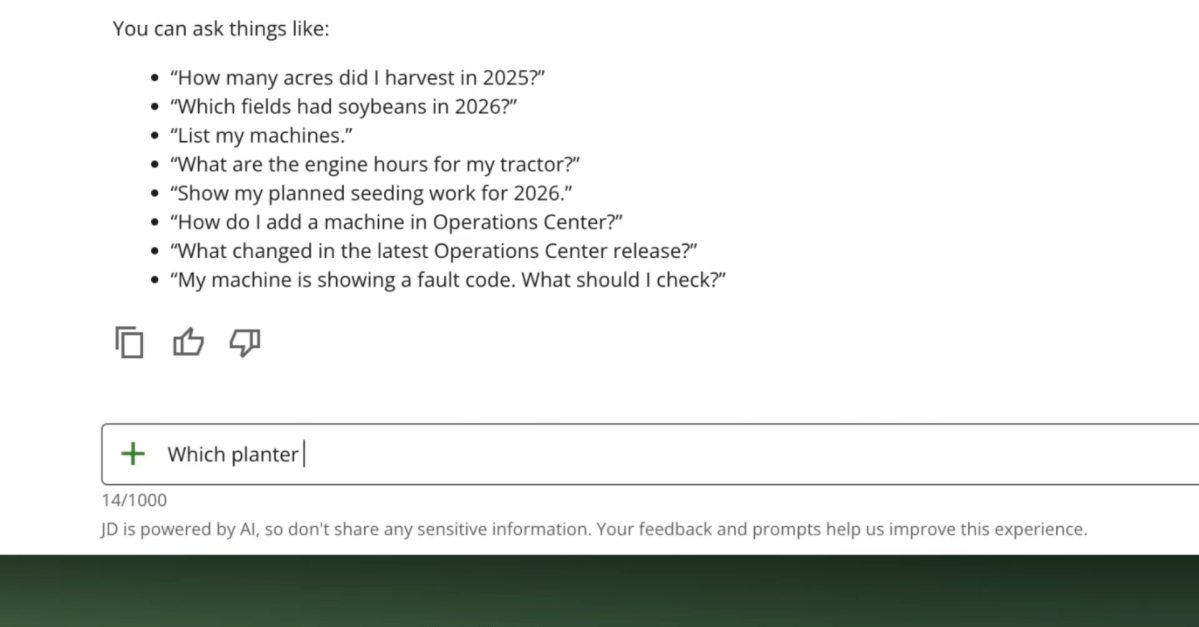
John Deere is putting a chatbot inside the software farmers already use to run their equipment. The assistant, called JD, launched September 1 at the Farm Progress Show in Iowa as part of a broader update to Deere's Operations Center platform, not as a standalone app. Farmers can type plain-language questions about fuel use, yields, seed variety comparisons, spray records, or machine efficiency, and JD answers using that farmer's own field, machine, and operational data rather than generic agronomy advice.
The rollout is narrow. Deere is limiting access to select US customers through web and mobile for now, with in-cab display integration promised for later. That staged approach matters for judging what's actually shipping: this is a controlled pilot layered onto an existing data platform, not a feature every Deere customer can open today.
Deere is framing JD partly as a response to how it has handled farmer data in the past. The company says in its launch materials that farmers control what gets shared, can cut off third-party data flows, and that farm data won't be sold or used for commodity speculation. That language reads as a direct answer to criticism Deere has faced for years over what happens to the data its machines collect.
The timing is awkward for that pitch. Deere is currently the subject of a data-privacy investigation opened in July by the law firm Migliaccio & Rathod, examining whether Operations Center and JDLink data was collected or monetized without adequate disclosure, the same platform JD now runs inside. And the company just closed out two separate right-to-repair fights: a $99 million class-action settlement with farmers in April and a July settlement with the FTC and five states, which put Deere under ten years of federal monitoring for restricting farmers' access to their own equipment's repair software. JD arrives on a platform that regulators and plaintiffs have spent the past two years arguing locks farmers out.
There's also a business backdrop worth noting. Deere's full-year revenue fell about 12% to roughly $45 billion, its Production and Precision Ag segment sales dropped, and the company is projecting a $1.2 billion hit from steel tariffs in 2026 along with a 15 to 20 percent drop in North American large-ag equipment sales, what Deere itself is calling the bottom of the cycle. Pushing further into Operations Center software and data services while hardware sales contract looks like a hedge, a way to extract more value per customer even as fewer new machines go out the door.
JD also isn't Deere's first AI bet. The company has been field-testing fully autonomous 8R tractors across 18 states and already sells See & Spray, a computer-vision system from its Blue River Technology acquisition that distinguishes weeds from crops in real time. A chatbot that reads a farmer's own yield and fuel logs is a smaller technical leap than either of those, and the real test won't be the demo on the Farm Progress Show floor. It will be whether farmers using the limited release trust an assistant built on the same data pipes that regulators are still investigating.