IBM to offer access to a dual-processor quantum system in 2027
IBM now plans to link just two 520-qubit Nighthawk chips for its 2027 system, down from nine, trading a bigger interconnect problem for a harder fabrication one.

Status
- Announced
- Demonstrated
- Available
- Independently confirmed
Sources
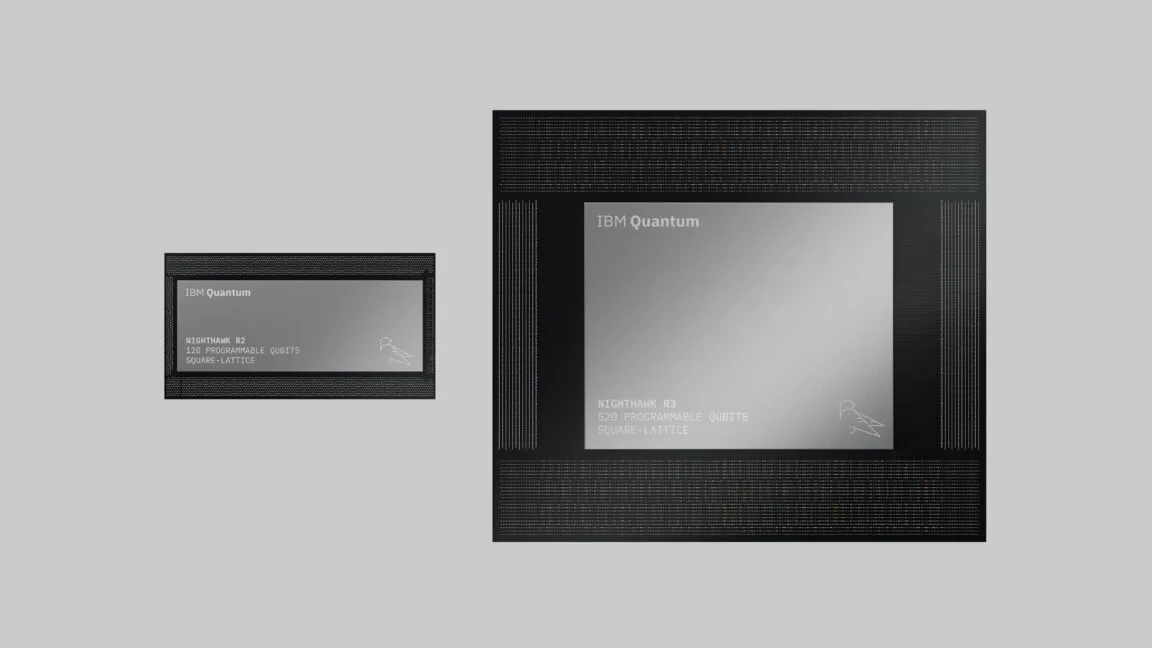
IBM used its Quantum Developer Conference this week to revise its hardware roadmap for 2027. The company now plans to link two 520-qubit Nighthawk processors into a single system, down from the nine-processor linkage it had described in earlier plans.
The total qubit count for next year's machine stays the same under either plan. What changes is the architecture used to reach that number, and that shift points to where IBM's engineers hit resistance.
Linking nine smaller processors needs nine sets of chip-to-chip couplers, nine sets of control electronics routed through a dilution refrigerator, and nine points where calibration drift or wiring loss can degrade a qubit's coherence. Two large processors cut that overhead to a quarter of that.
IBM has described its inter-chip coupling approach, built around what it calls L-couplers, as the mechanism that lets separate processors act as one larger lattice of qubits. Fewer couplers means fewer places for a connection to introduce noise, and noise is what limits how long a quantum calculation can run before it becomes useless.
The tradeoff is density. A single 520-qubit Nighthawk chip packs more circuitry onto one piece of silicon than IBM has fabricated before at that qubit count. So the near-term bottleneck moves from interconnect engineering to chip yield and wafer uniformity.
IBM wants error-corrected quantum computing running before the end of the decade, and the Nighthawk line is the test bed for that goal. Ars Technica's John Timmer reported the roadmap update from this week's conference, writing that IBM is "stepping back a bit on its plan to link multiple Nighthawk processors together, dropping the intended number of linked systems from nine to two."
A two-chip system also has fewer failure points for IBM's cloud customers to debug when they run error-mitigated circuits on current hardware. At this stage of the technology, that count of failure points matters more than the headline qubit total.
IBM has set 2027 as the year the dual-processor system reaches outside users through its cloud access program, the same channel it already uses to run time on existing Eagle and Heron processors. Whether two 520-qubit chips can hold together as cleanly as nine smaller ones might have is a question IBM's fabrication lines will answer well before any customer logs in.
Keep reading
-
 Google's orbital AI satellite writes a haiku, and a very expensive one
-
 Can AI data centers be mass-produced like cars? This startup aims to find out
-
 Altman-backed Volantis bets $88 million that lasers, not copper, will break AI's memory wall
-
 Nvidia's Cheaper DGX Spark Costs More Than the Machine It Replaced