Can AI data centers be mass-produced like cars? This startup aims to find out
Runware is building a factory to crank out shipping-container AI data centers it says can power on in 48 hours, but grid interconnection delays, not assembly speed, are what keep most projects waiting years.

Status
- Announced
- Demonstrated
- Available
- Independently confirmed
Sources
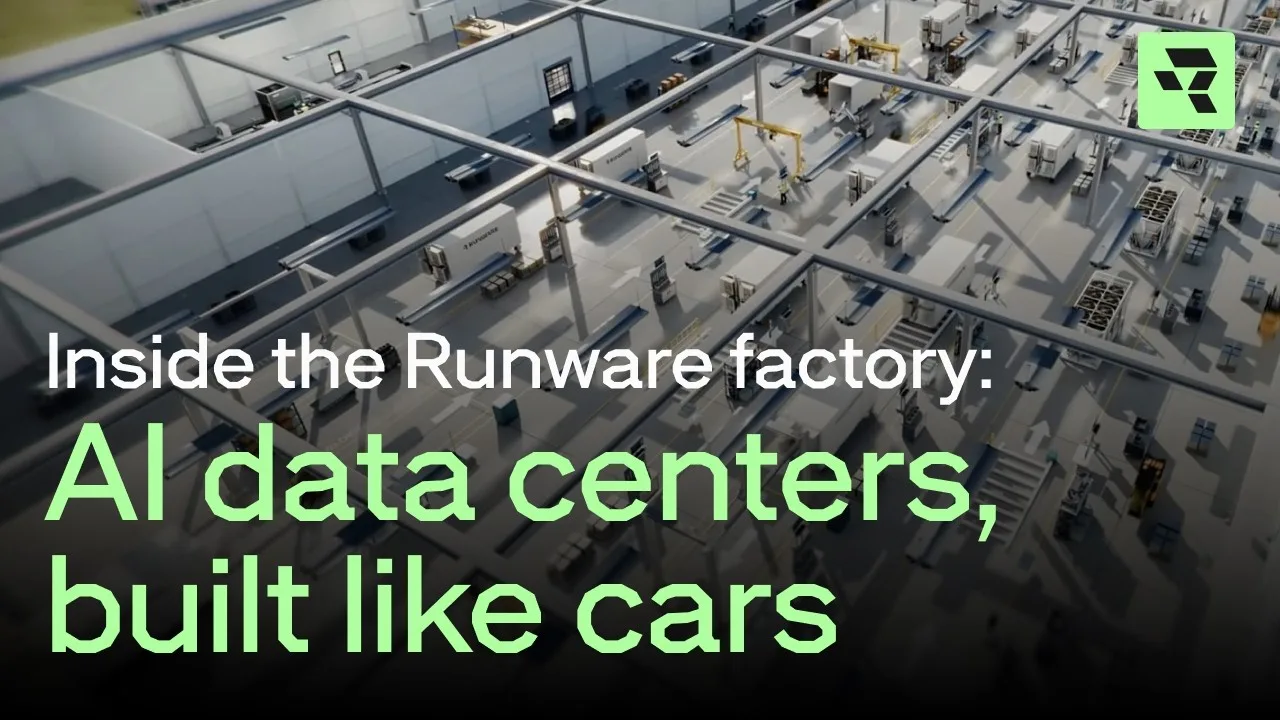
Runware wants to build AI data centers the way Detroit builds cars: on an assembly line, in standardized units, at volume. The London based startup, founded by Flaviu Radulescu, a former CTO at bare-metal hosting firm Bigstep, has built a 1 megawatt compute unit called the Sonic Inference Pod. It fits inside a 20 foot shipping container, packs more than 1,000 GPUs, and cools them with direct liquid lines that Runware says hold temperatures within 2 degrees Celsius of target. The company is now planning a factory, reportedly in Romania, meant to scale output toward 30 megawatts of capacity per day by 2028.
The pitch is speed. Runware's own marketing has cited deployment windows ranging from 48 hours to about a day to three weeks, depending on which page a reader lands on. Its cost claims shift too: one Runware page promises 30 to 90 percent lower inference prices, another says 30 to 80 percent less per GPU hour. A company moving this fast on messaging has not yet settled on a single number for either figure, and a buyer evaluating the pitch has to treat both ranges as provisional until a contract names one.
Runware did not start as a hardware company. It launched as a software layer for optimizing AI image and video generation, claiming up to 10x cost savings over standard inference setups, according to Insight Partners, one of its investors. It raised a $3 million seed round in October 2024, then a $50 million Series A in December 2025 backed by Dawn Capital, a16z Speedrun, Insight Partners, Comcast Ventures, and Speedinvest, bringing total funding to roughly $60 million. The company still leans on outside GPU supply: Together AI provides on-demand access to H100, H200, and B200 chips alongside Runware's own pod hardware.
The idea of mass-producing data center modules is not unique to Runware. Crusoe, which raised a $3.9 billion Series F in September 2026 at a roughly $30.9 billion valuation, opened its own prefab module factory in March and has built infrastructure for OpenAI. Fluidstack raised $830 million at a $7.5 billion valuation for prefabricated AI data centers and has worked on Anthropic's $50 billion infrastructure program. Armada, valued at $2 billion after a $230 million round that brought in BlackRock as an investor, is partnering with Johnson Controls, a 140 year old industrial conglomerate, to build a modular assembly factory in Arizona. Runware's container pod enters a field where several well-funded competitors already run factories of their own.
The harder question is whether factory speed solves the problem that actually slows AI buildouts. Industry analysis from Delta EMEA estimates that a data center breaking ground in 2026 may not receive stable grid power until 2030 or later. Transformer lead times run around 36 months on their own, independent of any interconnection queue. A pod that arrives on a flatbed truck and powers on in 48 hours still needs a grid connection, a substation, permits, and often years of waiting in a queue the hardware itself can't shorten.
A critique from remio.ai points at a separate gap in the pitch: the pod's 1 megawatt rating describes IT compute load only. Cooling pumps, power conversion equipment, and networking gear draw additional power at the site, so the real draw of a fully operational pod site exceeds 1 megawatt. The container itself ships plug-and-play. The land around it still needs grid delivery, heat rejection infrastructure, security, and local permits before the container does anything at all.
That gap matters because regulators are actively rewriting the rules around how large loads connect to the grid. In June 2026, the Federal Energy Regulatory Commission opened Section 206 show-cause proceedings on large-load interconnection and behind-the-meter generation, the kind of self-supplied power that could let a modular data center skip years of queue time. Whether Runware's pods are designed to run behind the meter, drawing power from on-site generation rather than the public grid, would tell a buyer more about the company's real timeline than any factory announcement. Runware hasn't said publicly whether that's part of the plan.