Waymo mastered city grids. Freeways exposed what its software was never trained on.
California pulled Waymo's robotaxis off every state freeway after one tried to pass two CHP cruisers mid traffic break on I-280 and after 11 construction zone mishaps in two months.

Status
- Announced
- Demonstrated
- Available
- Independently confirmed
Sources
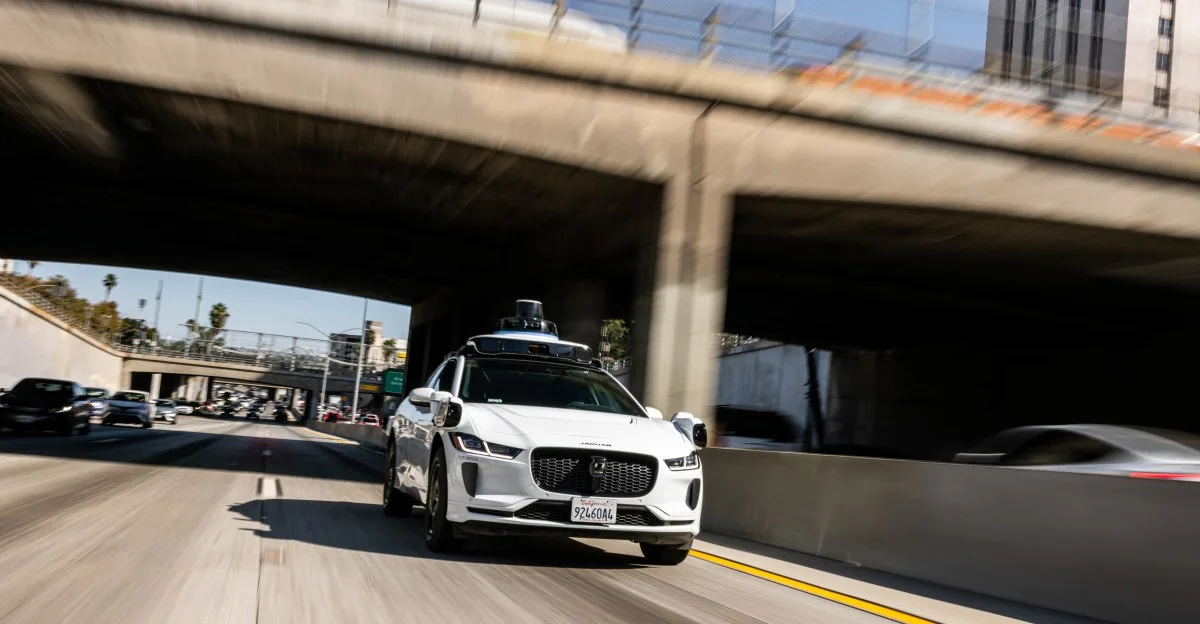
A driverless Waymo tried to pass two California Highway Patrol cruisers during a traffic break on Interstate 280 on November 6th. Dashcam video shows the robotaxi pulling into the lane the cruisers were using to slow traffic, then attempting to move around them. A human driver caught doing that risks a suspended license.
The California DMV responded last week by banning Waymo vehicles from all state interstates. The agency's order followed a string of freeway incidents the company itself had already logged. Between October and November 2026, Waymo reported 11 separate instances of vehicles behaving unpredictably in construction zones, including stopping in active lanes and misreading cone patterns meant to redirect traffic.
Waymo's robotaxis operate on a version of the company's Driver software that has been validated for dense urban grids: stop signs, four way intersections, pedestrians stepping off curbs, double parked delivery trucks. The company has spent years tuning that software against exactly those scenarios in Phoenix, San Francisco and Los Angeles, and it shows in the metrics Waymo publishes on crash rates in city driving. Freeways are a different operating envelope. Speeds are higher, lane changes happen in narrower windows, and the agents sharing the road include highway patrol units running maneuvers that have no equivalent in city traffic law.
A traffic break is one of those maneuvers. CHP officers position cruisers across multiple lanes and slow down, compressing traffic behind them so crews can clear a hazard or let another vehicle merge ahead. The maneuver depends on every car behind the cruisers matching their speed and staying in lane. Waymo's software read the two cruisers as slow moving obstacles to route around, not as a coordinated traffic control action, so it attempted a pass instead of falling in line.
The construction zone reports describe a related gap. Cone patterns that signal a lane shift to a human driver carry no fixed, learnable shape. Crews lay them out differently from site to site and adjust them hour to hour as work progresses. Waymo's perception stack, trained heavily on static urban infrastructure, had to infer intent from temporary, inconsistent markings, and in 11 cases over two months it inferred wrong.
California's suspension covers Waymo's entire freeway operation in the state, not a single route or city. Waymo has continued to run its city service during the ban, and the company told regulators it is working on updates to the Driver software that handle traffic breaks and construction zones as distinct cases rather than generic obstacles. No date for a freeway relaunch has been set.
The November 6th CHP video sits alongside the construction zone logs as the clearest evidence of what the suspension is actually about. Waymo's city driving record, built on years of recorded trips through dense traffic, is not in question here. The freeway failures are a narrower problem: a system tuned for stop and go streets meeting maneuvers, like a multi lane traffic break staged by two cruisers on I-280, that its training data never included.