Nvidia's RTX Spark Laptops Are Fast at Local AI, If You Buy the Right Configuration
Nvidia's RTX Spark chip, debuting in HP's OmniBook Ultra 16 and rivals, beats Apple's M5 Max and AMD's Halo on local AI inference, but memory bandwidth, RAM tier and price (up to $7,000) decide if it's worth it.

Status
- Announced
- Demonstrated
- Available
- Independently confirmed
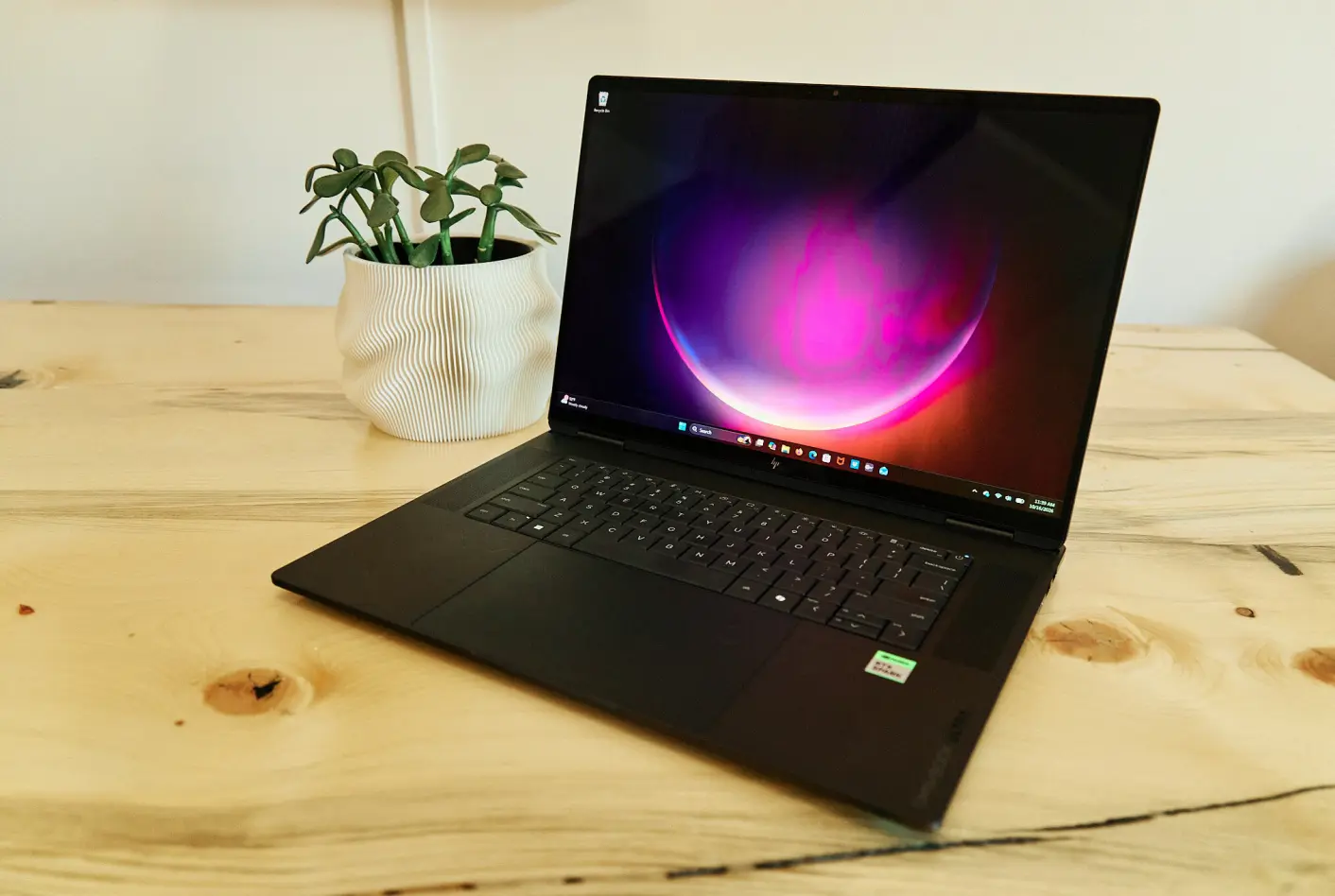
HP's OmniBook Ultra 16 went on sale this week carrying Nvidia's new RTX Spark chip, and The Register's benchmarks put a number on a question that has circulated since Nvidia teased this silicon months ago without naming a price: what do you actually get for it.
The chip is called N1X internally, and it is easy to confuse with Nvidia's other Spark product, the DGX Spark desktop that ships Linux and launched earlier this year on the GB10 Grace Blackwell Superchip. RTX Spark is the Windows laptop version of that same silicon class, now showing up in the HP OmniBook Ultra 16, the Microsoft Surface Laptop Ultra, the Dell XPS 16 Creator Edition and Lenovo's Yoga Pro 9n. The naming overlap is not an accident of branding alone; the underlying architecture really is related, which is part of why early buyers keep asking whether a laptop can do what the desktop does.
On raw numbers, it mostly can, within limits. Tom's Hardware measured local large language model inference at roughly twice the speed of AMD's Ryzen AI Max, the chip known as 'Halo' that has been the reigning champion of on-device AI in thin laptops. German outlet Borncity ran a Qwen3 27B model and found RTX Spark finished about 25 percent faster than a MacBook Pro on Apple's M5 Max. On a larger 35B model, the gap held: roughly eight minutes against ten for the Apple machine.
Those are the figures Nvidia will want quoted, and they explain the Register headline's claim of 'serious local AI compute.' The catch is memory bandwidth. RTX Spark runs at around 300 GB/s, which TechRadar points out trails Dell's Pro Max 18 Plus workstation laptop, a machine with memory bandwidth near 896 GB/s that still holds the overall crown for local-AI laptop performance. RTX Spark is not the fastest machine you can buy for running models at home; it is the fastest machine at this price and in this chassis size, which is a narrower and more useful claim.
Price is where the story gets complicated, because the number moved. Morgan Stanley analysts estimated back in June, based on checks ahead of Computex, that flagship N1X machines would land near $2,899, with entry configurations as low as $1,799. PC Gamer's reporting on actual launch pricing shows configurations spanning $2,600 to $7,000. The Surface Laptop Ultra starts at $2,599; the Dell XPS 16 Creator Edition starts at $3,799.99. The HP OmniBook Ultra 16 that The Register tested sits inside that range, and the review's own framing, 'at a price,' is doing real work: this is capable hardware sold at workstation money inside a laptop body.
PC Gamer's pricing breakdown carries a warning worth repeating here: the 24GB RAM configuration of RTX Spark laptops is a poor fit for the larger local models that are the whole point of buying this chip, and a conventional RTX 5070 Ti gaming laptop with 16GB of VRAM can be bought for roughly $1,000 less if local AI inference is not actually the daily workload. That is the kind of detail that separates a demo from a decision. A shopper chasing the Qwen3 and Borncity-style benchmark numbers needs to check which memory tier they are actually buying, not just the chip name on the spec sheet.
There are real tradeoffs beyond memory. HotHardware's power testing ranks the RTX Spark platform near the bottom of the field on minutes of battery life per watt-hour, despite the large die size, which is an odd result for something sold as a notebook rather than a desktop replacement. Gaming and CPU-heavy workloads are the other soft spot: Apple's M5 and M5 Pro still win multi-core benchmarks despite RTX Spark's 20-core Arm CPU holding its own on single-core tests, and reviewers have flagged latency issues with DLSS Frame Generation in CPU-bound titles. The GPU itself benchmarks comparably to an RTX 5070 Laptop GPU, strong for a thin laptop, but a reminder that this silicon was built for AI inference workloads first and everything else second.
The pricing turbulence is not unique to the laptop chip. Nvidia's desktop sibling, DGX Spark, launched as 'Project Digits' at $3,999 for a 128GB configuration before Nvidia raised the list price to $4,699, a roughly 33 percent increase that the company and outlets covering it attributed to constrained global memory supply, according to TechRadar's reporting on the hike. A 64GB variant was set to launch at $4,999 through partners including Acer, Asus, Dell, Gigabyte, HP and MSI on October 23. Retail listings in late September were already running above Nvidia's own list price as its store went out of stock, a supply signal that suggests anyone eyeing a well-specced RTX Spark laptop at launch pricing should not expect those prices to hold steady either way.
What a buyer takes from the benchmarks published this week is narrower than the headline numbers suggest. RTX Spark laptops run local language models faster than anything else at this size and price, by a comfortable margin against both Apple silicon and AMD's Halo chip. They are not the fastest local-AI machines available at any price, they trade battery life and gaming performance for that inference speed, and the memory configuration a buyer actually selects at checkout matters more than the chip name does. The HP OmniBook Ultra 16 that The Register tested is a real, shipping answer to a question Nvidia left open for months. Whether it is the right answer depends on how much RAM is in the box.
Keep reading
-
 Amazon's Bee Finally Ships Hardware, But the Memory and Consent Questions Still Aren't Answered
-
 YouTube Music starts tagging AI-generated songs, with YouTube's main app still waiting its turn
-
 Deezer's AI Music Toggle Is Narrower Than It Sounds
-
 Spotify’s Siri shortcut on iOS 27 depends on Apple Intelligence learning your habits