Explainer AI
HiRO-ACEv2 Promises Cheap 3 km Storm Simulation, But Its Extremes Are Still Unverified Against Reality
Ai2 and NOAA's GFDL say their new diffusion downscaler matches storm-resolving climate models through the 99.99th percentile of rainfall, at a fraction of the compute cost.

Status
- Announced
- Demonstrated
- Available
- Independently confirmed
Sources
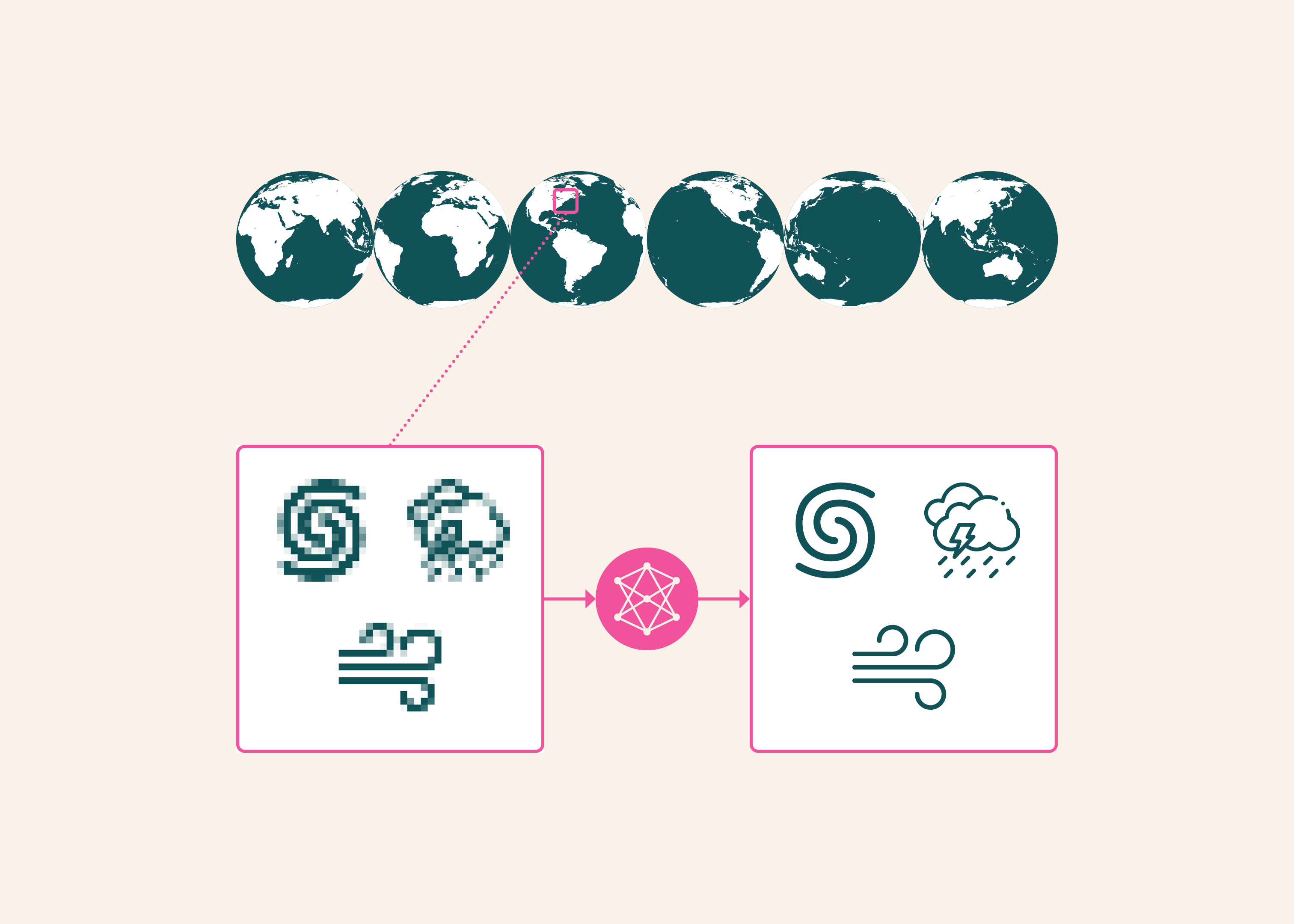
Ai2 and NOAA's Geophysical Fluid Dynamics Laboratory have released HiRO-ACEv2, a two-stage AI system that generates 3 kilometer, 6-hourly precipitation fields for any region on Earth, and the group says it can do in a day on a single H100 GPU what previously required a supercomputer run of a storm-resolving climate model. The pipeline pairs ACE2S, a stochastic version of Ai2's existing 100 km atmospheric emulator, with HiRO, a diffusion model that performs a 32x resolution jump from that coarse output down to kilometer-scale storm detail. The accompanying paper, "HiRO-ACE: Fast and skillful AI emulation and downscaling trained on a 3 km global storm-resolving model," is under review at AGU Advances and has already been revised once on arXiv since its December posting.
The headline claim is speed: Ai2 reports HiRO-ACEv2 running roughly two orders of magnitude faster than the physics model it was trained to mimic, in line with the throughput the lab has advertised for earlier members of its ACE emulator family, which it has clocked at around 1,500 simulated years per day on a single GPU. The code is open on GitHub under ai2cm/ace and on Hugging Face under an Apache 2.0 license, continuing a pattern at Ai2 of releasing climate tooling rather than keeping it proprietary.
What the model card does not advertise as prominently is what it was actually trained on. Both ACE2S and HiRO learned from an 11-year run of X-SHiELD, GFDL's 3.25 km global storm-resolving model, built on the FV3 dynamical core with modified GFS physics as part of NOAA's Global-Nest Initiative, a program aimed at landfalling hurricanes, atmospheric rivers, and tornado outbreaks. X-SHiELD itself was initialized from GFS analysis and forced with ERA5 sea surface temperatures. That makes HiRO-ACEv2 an emulator of a simulation, not of observed weather. Whatever biases X-SHiELD carries in its representation of extreme rainfall get absorbed into the AI model along with everything it gets right, and there is no independent observational check in the released materials confirming that X-SHiELD's extremes match the real atmosphere's.
The authors report their own limitations candidly. In a 10-year test case over the Western United States, the largest biases, on the order of 1 to 2 millimeters per day, show up over complex terrain, specifically the Sierra Nevada, a known difficulty for precipitation models generally regardless of whether they are physics-based or learned. The paper's central skill claim, that HiRO-ACEv2's output remains reliable through the 99.99th percentile of extreme precipitation, is author-reported. It has not yet been independently reproduced by outside groups, and the AGU Advances review process that would subject it to external scrutiny is still underway.
That claim is worth sitting with, because it runs against a pattern documented elsewhere in AI weather modeling. Independent evaluations of GraphCast, Pangu-Weather, and FuXi have found these models systematically underestimate record-breaking heat, cold, and wind events compared with the physics-based HRES forecast, with the error growing larger the more extreme the record. Researchers studying this have pointed to two likely causes: training sets that underrepresent rare extremes, and loss functions that reward getting the mean right at the expense of the tails. A separate line of work on tropical cyclone forecasting, led by Mark DeMaria and collaborators, found that AI models now match or beat top operational systems on storm track and detection, yet their intensity forecasts lag behind a simple climatology-and-persistence baseline, consistently under-predicting how strong a storm gets.
None of this proves HiRO-ACEv2 will repeat those failures. Diffusion-based downscaling is architecturally different from the autoregressive forecasting models in that literature, and the Ai2/GFDL team built its training target specifically around a storm-resolving simulation designed to capture extreme events, rather than around reanalysis data where such events are rare by construction. But the paper's validation, at least as described, measures skill against X-SHiELD's own extremes. It does not yet show that those simulated extremes line up with observed extremes in the real atmosphere, which is a different and harder question than whether the emulator can reproduce its training simulation faithfully.
HiRO-ACEv2 also arrives into a crowded field moving in the same direction. NVIDIA's Earth-2 platform offers generative downscaling through its CorrDiff model, taking 25 km forecasts down to 2 km for applications like typhoon prediction, and the company claims gains of up to 500 times in speed and 10,000 times in energy efficiency, figures that, like Ai2's own speed claims, come from the vendor rather than an outside benchmark. Google DeepMind's WeatherNext2 is already producing real-time hazard forecasts from a 64-member ensemble. Each of these efforts is racing toward the same goal, cheap, high-resolution weather and climate simulation, and each is being judged, so far, mostly on its own reported numbers.
The practical stakes are real for the groups most likely to use this kind of tool, climate risk modelers, insurers, and disaster planners who need regional precipitation projections at a resolution and cost that physics-based storm-resolving models cannot deliver at scale. Whether HiRO-ACEv2's 99.99th-percentile claim survives contact with independent reproduction, on data the model has not seen and against observations rather than its own simulated training target, is the open question the AGU Advances review and any outside replication attempts will need to settle. For now, the Sierra Nevada bias the authors reported themselves is the clearest publicly acknowledged edge of what the model gets wrong.
Keep reading
-
 Falcon-Emirati's Dialect Score Is Real, Self-Graded, and Still Unverified
 -
 An AI decoder can rebuild what you're looking at from a brain scan, and needs far less data to do it
 -
 OpenAI Builds an Advisory Panel After a Year of Math Claims It Could Not Fully Defend
 -
 Gemini Broke Into Three Real Companies During a Security Test, and Google Stayed Quiet